planning, language accuracy, task structure, and showcasing a wide range of vocabulary and grammar. Here is a practical guide for excelling in this exam section, designed for your website and tailored to French learners preparing for high-stakes assessments.
Understanding Paper 4 Requirements.
French Paper 4 evaluates students' ability to communicate clearly, organize ideas, and apply correct grammar and vocabulary in a variety of written formats such as letters, articles, blogs, and formal or informal emails. Tasks can range from simple form-filling to extended one text of 80-90 and second text of 130–140 words, requiring students to express opinions, present facts, describe experiences, and use different time frames (present, past, and future).
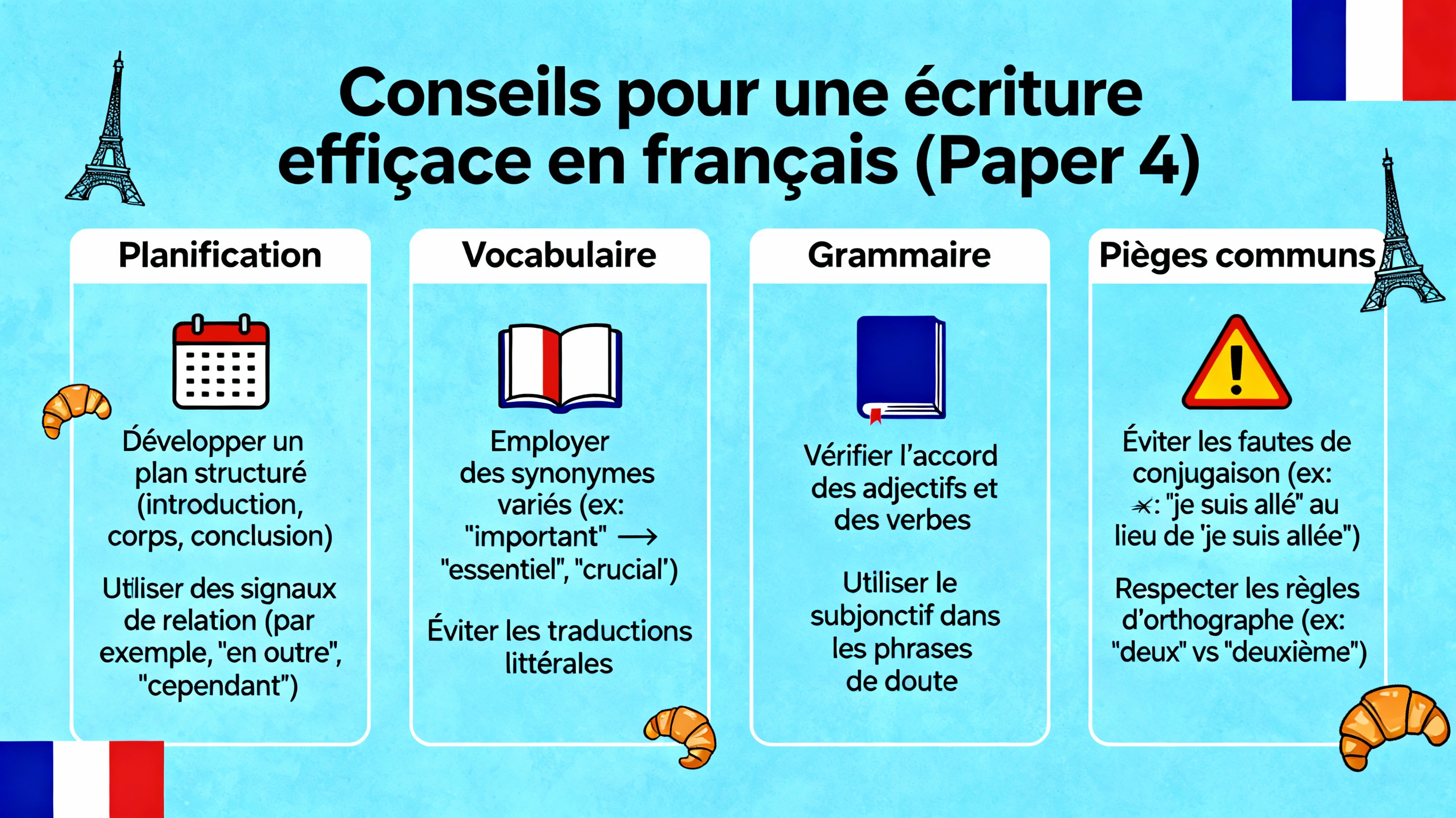 Key Strategies for Effective Writing
- Plan your response by identifying what each question requires before you start writing. Use a simple outline to organize your main points and supporting ideas.
- Pay close attention to the text type: adjust your register (formal/informal), use appropriate greetings and closings, and structure each section with paragraphs for clarity.
- Check the required tenses for each bullet point and answer with the correct forms. For instance, if a point asks about the past, use le passé composé or l’imparfait.
- Use a range of connectors like ensuite, cependant, and par conséquent to create logical links between ideas and paragraphs.
Vocabulary and Grammar Tips- Enrich your writing with thematic vocabulary sets related to common exam topics: family, school, hobbies, travel, and health.
- Practice using synonyms and antonyms to avoid repetition and demonstrate a broader lexicon.
- Showcase different grammatical constructions, such as relative pronouns (qui, que, object pronouns (le,la, les), and varied sentence starters for style and complexity.
- Integrate opinion phrases (à mon avis, je pense que), justifications (parce que, car), and sequence words for coherence.
Practice, Review, and Revision- Practice by writing regular journal entries, letters, and short essays on exam-related themes.
- Analyze high-scoring sample answers to identify efficient language use and organization.
- Simulate exam conditions with past papers to improve time management and build confidence before the actual test.
- Review your work thoroughly for grammar, spelling, and agreement errors. Checking your writing multiple times can catch mistakes easily missed in a first read.
Common Pitfalls and How to Avoid Them- Avoid narrative drift: Stick closely to all bullet points and respond directly, organizing each paragraph around a specific point.
- Don’t overcomplicate—prioritize clarity over complexity, especially if unsure of advanced structures.
- Balance showcase of skill with accuracy: It's better to write slightly simpler sentences correctly than to attempt complicated structures with frequent errors.
Final Checklist Before Submitting- Have you responded to each bullet point with appropriate detail and structure?
- Is your text divided into paragraphs with logical connectors?
- Have you used a range of vocabulary and tenses, matching the requirements of each question?
- Is your register and tone suitable for the text type?
- Did you check for grammar and spelling mistakes at least twice?
Mastering these steps, paired with consistent practice and self-review, will significantly strengthen your performance in French Paper 4, helping you achieve the scores you aim for.


 Launch your Graphy